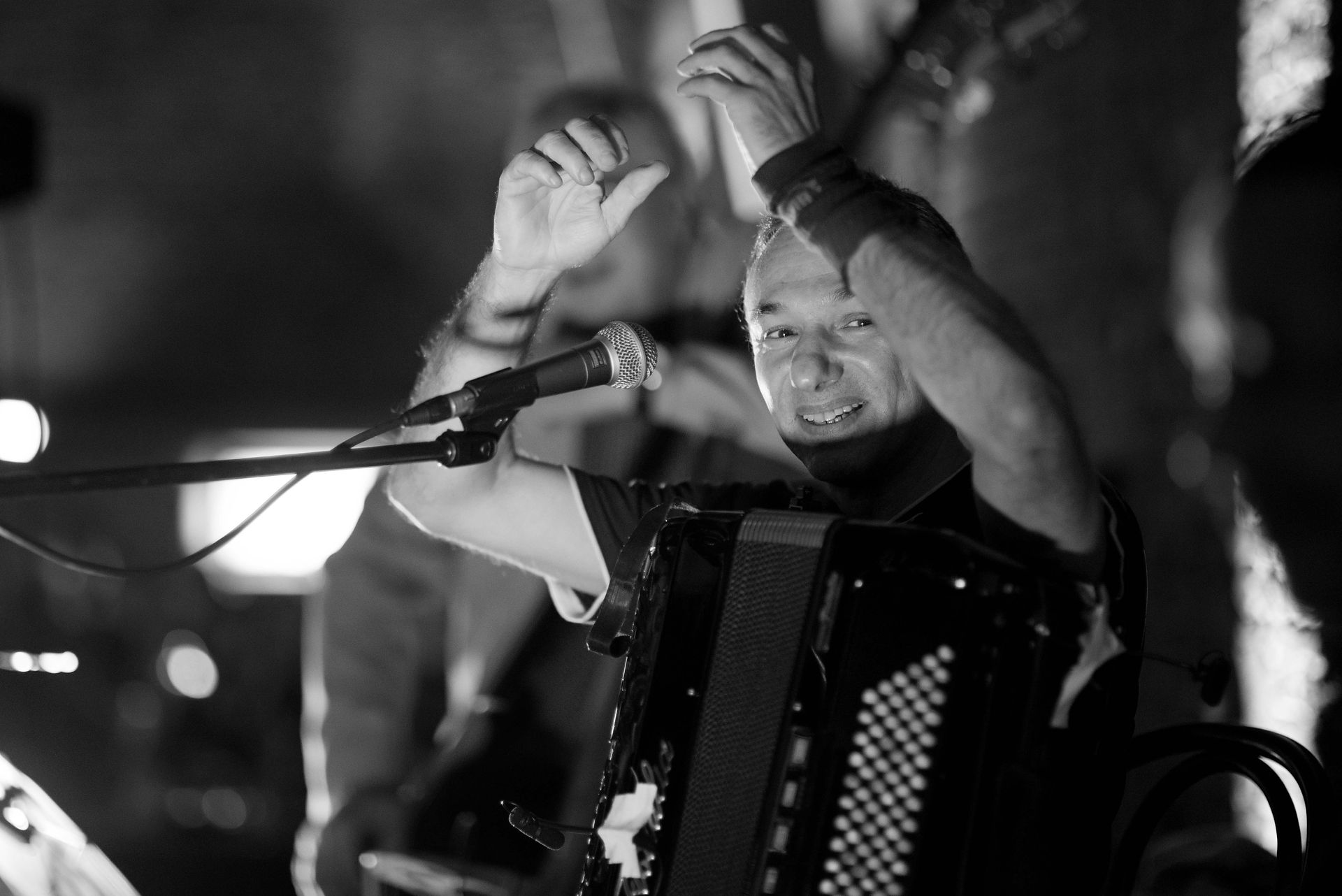

RENE SOPA BIO

René Sopa is a jazz and world music accordionist. His parents left Faro, in the Algarve (Portugal), to settle in Cannes, in the district of La Bocca, where he grew up. At the age of nine, a school friend and neighbour introduced him to Lucien Galliano, with whom he began studying the accordion. His cousins Alvaro Carminho and Mario, who remained in Portugal, also played the accordion in folkloric ensembles. During his holidays in Portugal, René regularly listened to his cousin Alvaro performing corridinhos, traditional Portuguese pieces. A few years later, they would play together. Lucien Galliano taught him music theory, accordion technique and the musette repertoire. At the same time, René learned to play by ear, interpreting popular songs from the 1970s. He won his first regional competitions and, through his teacher, discovered major accordion figures such as Joss Baselli, Gus Viseur, André Astier, as well as recordings by Richard Galliano and Art Van Damme. At the age of sixteen, he began improvising on the accordion, formed a trio to perform at various events and played in the Portuguese folkloric ensemble of La Bocca. Listening to jazz recordings, including Lionel Hampton, Chick Corea and Carlos Santana, gradually shaped and refined his musical language. In 1979, he adopted the chromatic bass system and won the Young Accordionist Trophy at Télé Monte-Carlo, chaired by Joss Baselli, who invited him three times to appear on his television programme Le Monde de l’accordéon, broadcast on TF1. During this period, René also worked as drummer and accordionist with the Arpège Orchestra in Grasse, and studied percussion for four years at the National Conservatory of Nice, in the class of Rodolphe Palumbo. He explored the classical repertoire, including works by Solotarev and Johann Sebastian Bach, and won the finals of the UNAF competition in 1979 (advanced category), followed by the ACF competition in 1981. In 1982, he reached the grand final of Les Princes de l’Accordéon in Nogent-sur-Marne. Throughout these years, he practised improvisation daily, playing along with jazz records. From 1987 to 1991, René performed in the two largest dance halls on the French Riviera, earning his living entirely as a professional musician. In 1993, he focused more intensely on composition and recorded his first CD, El ritmo del sol. He later performed at the Nice Jazz Festival in 1995 and 1996, as well as in numerous clubs and concert venues in the region. After moving to Paris in 1999, he met young Belgian violinist Alexandre Cavalière. Together, they performed at prestigious festivals in France and abroad, alongside musicians such as Angelo Debarre, Dorado Schmitt, Sanson Smith, and Christian Escoudé, among others. In 2003, René released his fourth album, Sandunga, on the Harmonia Mundi label. In 2005, he recorded an album in Strasbourg, a city known as a cradle of young gypsy jazz guitarists, with Dino Mehrstein. The year 2006 marked the beginning of his collaboration with organist Stéfan Patry, introduced by his friend Alain Bois. This collaboration gave birth to the project Hammondéon, featuring François Morin on drums and Jacquot Largent on percussion (former member of Sixun). The piece Carinhos Tango was recorded with Marcel Loeffler and Aurélien Noël. After recording more than fifteen albums, René Sopa has been travelling the world with his accordion for over three decades, developing a distinctive musical voice that blends jazz, world music, improvisation and popular traditions.
René Sopa est un accordéoniste de jazz
Ses parents quittent Faro, en Algarve (Portugal), pour s’installer à Cannes, dans le quartier de La Bocca. À l’âge de 9 ans, un ami, camarade d’école et voisin, lui présente Lucien Galliano, auprès de qui il commence l’étude de l’accordéon. Ses cousins Alvaro Carminho et Mario, restés au Portugal, jouent eux aussi de l’accordéon dans des ranchs folkloriques. Chaque année, pendant ses vacances au Portugal, il écoute son cousin Alvaro interpréter des corridinhos (morceaux traditionnels portugais). Quelques années plus tard, ils joueront ensemble. Lucien Galliano lui enseigne le solfège, l’accordéon et le répertoire musette. Très tôt, il apprend également à jouer d’oreille les airs populaires des années 1970. Il remporte ses premiers concours régionaux et découvre, grâce à son professeur, les grands noms de l’accordéon : Joss Baselli, Gus Viseur, André Astier, ainsi que des enregistrements de Richard Galliano et Art Van Damme. À 16 ans, il commence à improviser à l’accordéon, forme un trio pour animer des soirées et joue au sein du ranch folklorique portugais de La Bocca. L’écoute de disques de jazz, notamment de Lionel Hampton, Chick Corea ou Carlos Santana, contribue à affiner progressivement son langage musical. En 1979, il adopte les basses chromatiques et remporte le Trophée du Jeune Accordéoniste à Télé Monte-Carlo, sous la présidence de Joss Baselli, qui l’invite à trois reprises dans son émission Le Monde de l’accordéon, diffusée sur TF1. Parallèlement, il est batteur et accordéoniste au sein de l’orchestre Arpège de Grasse et s’inscrit au Conservatoire national de Nice, où il étudie les percussions pendant quatre ans dans la classe de Rodolphe Palumbo. Il travaille le répertoire classique, notamment Solotarev et Jean-Sébastien Bach, et remporte à Paris les finales des concours UNAF (1979, catégorie supérieure) puis ACF en 1981. En 1982, il participe à la grande finale des Princes de l’accordéon à Nogent-sur-Marne. Il pratique quotidiennement l’improvisation en jouant sur des enregistrements de jazz. De 1987 à 1991, il se produit dans les deux plus grands dancings de la Côte d’Azur, vivant pleinement de son métier d’artiste. En 1993, il s’engage davantage dans la composition et enregistre son premier CD, El ritmo del sol. Il se produit ensuite en 1995 et 1996 au Festival de Jazz de Nice, ainsi que dans de nombreux clubs et salles de la région. Installé à Paris en 1999, il rencontre le jeune violoniste belge Alexandre Cavalière. Ensemble, ils participent à de prestigieux festivals en France et à l’étranger, aux côtés de musiciens tels que Angelo Debarre, Dorado Schmitt, Sanson Smith, Christian Escoudé, entre autres. En 2003, il sort son quatrième album, Sandunga, chez Harmonia Mundi. En 2005, il enregistre à Strasbourg, berceau de nombreux jeunes guitaristes manouches, un disque avec Dino Mehrstein. L’année 2006 marque sa collaboration avec l’organiste Stéfan Patry, présenté par son ami Alain Bois. De cette rencontre naît le projet Hammondéon, réunissant également François Morin (batterie) et Jacquot Largent (percussions, ex-Sixun). Le titre Carinhos Tango est enregistré avec Marcel Loeffler et Aurélien Noël. Après plus de quinze albums enregistrés, René Sopa parcourt le monde avec son accordéon depuis plus de trois décennies, développant un univers musical personnel entre jazz, musiques du monde, improvisation et héritage populaire.
 Au Luxembourg en 2005 |  En Belgique |  René Sopa Stéphane PatrySanary sous les Etoiles avec Stefan patry |  Avec Michel Benebig TrioNouméa en 2014 |
|---|---|---|---|
 Avec Sébastien GiniauxConcert chez Moriau à Bruxelles |  Avec Nicolas PautrasA la Cave du Jazz en 2014 |  Gilles Renne et Christophe BrassA la Cave du jazz en 2014 | Avec Nicolas PautrasA la Cave du jazz en 2014 |
 Au Luxembourg en 2005 |